 how-to
Fire Risk Assessment Requirements: A 2026 Guide
Table of Contents
- Fire Risk Assessment Requirements: Who Must Comply
- Fire Risk Assessment Steps for Cafés and Restaurants
- Fire Risk Assessment Review Frequency and Record Keeping
- Frequently Asked Questions
Last Updated: October 14, 2026
Fire Risk Assessment Requirements: Who Must Comply
Every UK business with employees, or premises the public can enter, must carry out a fire risk assessment under the Regulatory Reform (Fire Safety) Order 2005, cafés, restaurants, hotels and catering vans alike. The law names a "responsible person" who must record the findings, act on them and keep them current.
The responsible person is usually the owner, employer, or whoever controls the premises, you, if you run a café, or manage a hotel's shared areas. Lease a food court unit and you may share the duty with the landlord. A fire risk assessment is a written review of what could start a fire, who could be hurt, and what you are doing to stop it.
Who must comply: any employer with one or more staff; anyone controlling premises open to the public; landlords for shared parts of a building; self-employed people whose workplace is open to others; and charities and volunteer-run kitchens.
You can read the full duty on the legislation.gov.uk page for the Regulatory Reform (Fire Safety) Order 2005. The government's own guidance for small premises sits on GOV.UK fire safety guidance for businesses. Both are free, and they are the version an inspector will use.
Fire Risk Assessment Steps for Cafés and Restaurants
A kitchen fire risk assessment follows five steps: spot the hazards, decide who is at risk, remove or reduce the risk, record and plan, then review. In a café or restaurant the hazards are predictable: cooking oil, extract ducting, gas hobs, deep-fat fryers and overloaded sockets.
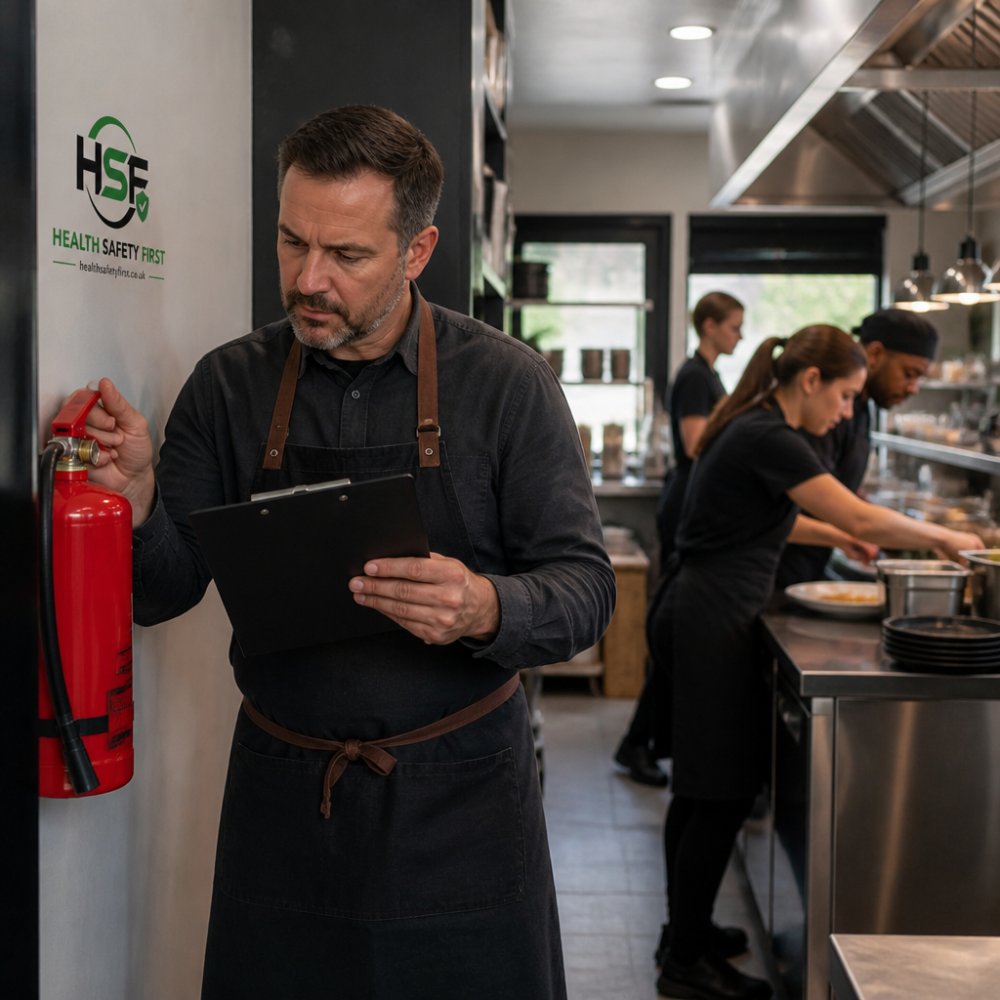
Walk the site and write down what you find, do not rely on memory. Then work through this checklist:
- Cooking equipment cleaned and serviced on a set schedule
- Extract filters and ducting free of grease build-up
- Fire extinguishers in place, in date, and the right type for oil
- Fire blanket within reach of every hob
- Escape routes clear and never blocked by stock
- Emergency lighting and smoke alarms tested weekly
- Staff trained on what to do if a pan catches fire
- Gas and electrical certificates up to date
A fire risk assessment template helps: a good one lists each hazard, the action needed, who owns it, and the date it was done.
The fire risk assessment steps are a loop: spot it, fix it, write it down, check it again next month.
Fire Risk Assessment Review Frequency and Record Keeping
Review your fire risk assessment at least once a year, and sooner if anything changes, new equipment, a refit, more staff, or a change in how you use a room. Keep the record for as long as the premises are in use, and hand it over if you sell or move out.
Your record should hold: the date of the assessment and who carried it out; every significant finding and the action taken; who is responsible for each action; the date each action was completed; and your review dates going forward.
Fire risk assessment review frequency is where small operators slip. A café that adds a second fryer in March cannot wait until next January to update the file, update it the week the fryer arrives.
A fire risk assessment checklist is only useful if the team can find it. Keep one copy in the office and one on the floor.
Fire safety paperwork is not the part of running a café anyone enjoys, but it keeps you trading. UK Health, Safety & Fire Guide provides comprehensive resources for navigating essential health, safety, and fire standards. Empower your business to achieve full compliance and foster a safe working environment. This platform serves as an indispensable tool for maintaining legal adherence and operational safety within the UK market.
Frequently Asked Questions
Is a fire risk assessment a legal requirement for my business?
Yes. Under the Regulatory Reform (Fire Safety) Order 2005, every business in England and Wales must have a suitable and sufficient fire risk assessment. In Scotland, the Fire (Scotland) Act 2005 applies. As the responsible person, you must assess fire risks, record significant findings, and put safety measures in place. Small cafés and restaurants are not exempt, though the level of detail should match the size and risk of your premises.
How often should a fire risk assessment be reviewed?
Review your fire risk assessment at least annually, or sooner if anything changes. This includes new equipment, refurbishment, a change in occupancy, or after any fire incident or near miss. High-risk kitchens with cooking equipment may need more frequent reviews. Regular reviews keep your fire risk assessment requirements up to date and help you pass inspections without last-minute panic.
Can I carry out a fire risk assessment myself?
You can complete a fire risk assessment yourself if you are competent to do so. For small, low-risk premises, a fire risk assessment template and checklist can guide you through the fire risk assessment steps. If your kitchen has complex equipment, multiple floors, or sleeping guests, a qualified assessor is safer. Either way, you must record the findings and act on them.
What records should I keep after a fire risk assessment?
Keep the completed fire risk assessment document, your fire risk assessment checklist, any fire risk assessment template you used, and evidence of actions taken. Record staff fire safety training, equipment maintenance, and drill dates. Store records so they can be shown to enforcing authorities on request. Retain them for at least three years, or longer if your insurer requires it.