 how-to
7 Manual Handling Weight Limit Rules for UK Workplaces
Last Updated: 3 November 2026
Quick Summary
There is no single legal manual handling weight limit in the UK that applies to every worker and load. The Manual Handling Operations Regulations 1992 require employers to avoid hazardous handling, assess the risk and reduce it as far as reasonably practicable, with no fixed kilogram figure written into the regulations. HSE guideline figures of 25 kg for men and 16 kg for women are a risk filter, not legal limits.
- HSE guideline figures of 25 kg for men and 16 kg for women apply only close to the body at waist height with no twisting.
- A load lifted from the floor with a twist, even at 10 kg, can be medium or high risk if repeated.
- A reach of more than about 30 cm lowers the safe weight and pushes the task into medium risk.
- Nominate one leader who calls the lift, move and set-down when two or more people handle a load together.
- Training supports the controls you choose but does not replace reducing the weight, height or frequency of the lift.
Table of Contents
- Is There a Legal Maximum Manual Handling Weight in the UK?
- The HSE Guideline Figures: 25 kg, 16 kg and the Risk-Filter Zones
- Your Manual Handling Risk Assessment Template, Step by Step
- What Employer Health and Safety Responsibilities Require
- Carrying, Pushing, Pulling and Team Handling: Beyond Lifting
- Manual Handling Training Requirements for Hospitality Teams
- When the Load Cannot Be Reduced: Practical Controls That Work
- Put These Manual Handling Rules Into Practice This Week
- Frequently Asked Questions
Is There a Legal Maximum Manual Handling Weight in the UK?
No. UK law sets no single maximum manual handling weight limit in the UK that applies to every worker and every load.
Instead, the law asks whether a load is safe for this person, in this task, in this environment.
Small hospitality teams are often caught out by the gap between what the law says and what people assume. This guide sets out the rules and how to follow them.
The HSE Guideline Figures: 25 kg, 16 kg and the Risk-Filter Zones
The Health and Safety Executive publishes guideline figures, not legal limits. These help employers decide when a more detailed risk assessment is needed.
The classic figures are 25 kg for men and 16 kg for women. They apply to lifting a load close to the body, at waist height, in good conditions, with no twisting. The HSE guidance on manual handling assessment explains these as a filter, not a pass mark.
Why the 25 kg and 16 kg Figures Are Not Safe Limits
A guideline figure assumes the best possible conditions. Change any of them and the safe weight drops fast.
- Reaching away from the body reduces the safe weight
- Twisting or bending adds strain
- Lifting from floor level or above shoulder height is harder
Watch out: treating 25 kg as a guarantee of safety is the most common mistake. The figures are a prompt to assess, never a green light.
The HSE guideline figures are a risk filter, not a legal limit, and they only hold in favourable conditions.
| Item | Value | Note |
|---|---|---|
| Guideline figure for men | 25 kg | Close to the body, waist height, no twisting |
| Guideline figure for women | 16 kg | Close to the body, waist height, no twisting |
| Reach that lowers safe weight | More than about 30 cm | Load becomes medium-risk |
| Load lifted from floor with a twist | 10 kg | Can be medium or high risk if repeated |
| Legal maximum weight in UK law | None | Regulations set no fixed kilogram figure |
Your Manual Handling Risk Assessment Template, Step by Step
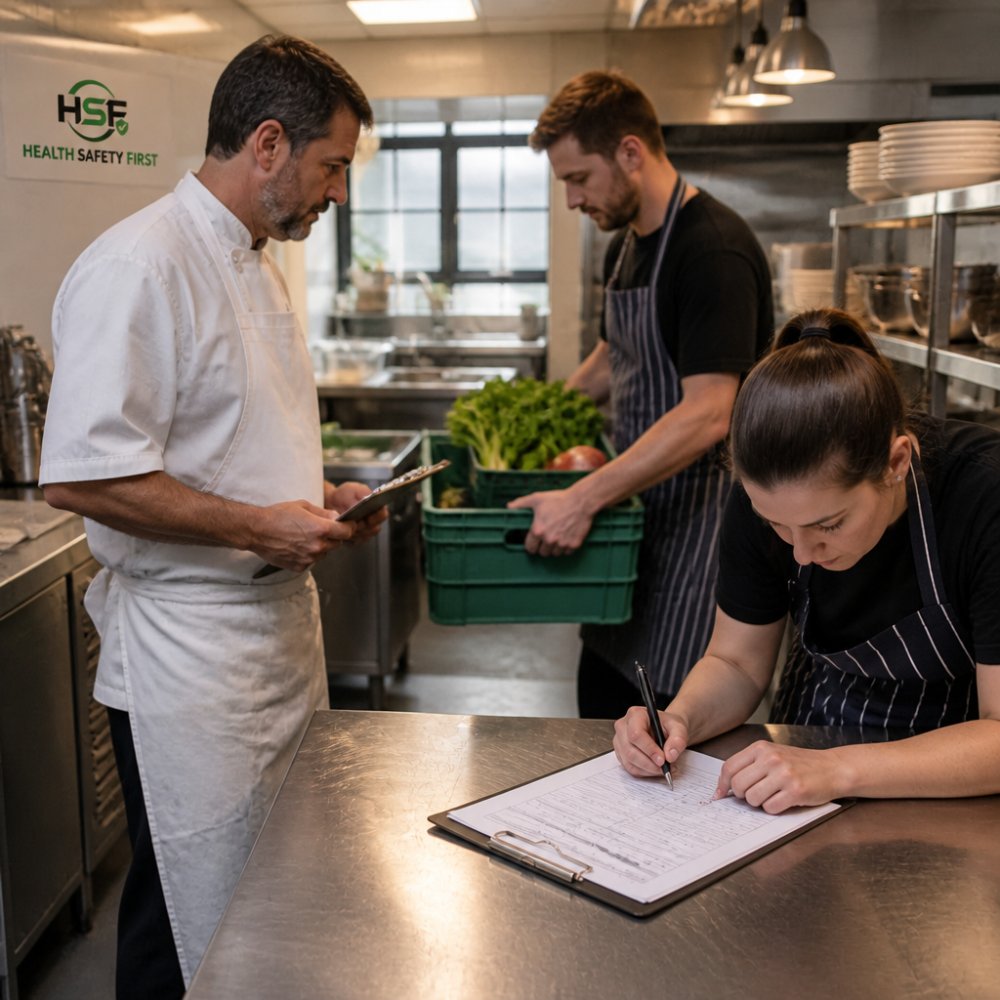
A manual handling risk assessment is a written record of each hazardous handling task and the steps taken to make it safer. The HSE uses four filters: the task, the individual, the load, and the environment.
- List the task. Name the operation and where it happens. Example: unloading 25 kg produce crates from a tail-lift into a café kitchen.
- Check the task. Note lifting, lowering, carrying, pushing, pulling, twisting, and frequency. Here, crates are lifted from the tail-lift at knee height, carried four metres, and stacked at waist height, roughly twenty times per delivery.
- Check the individual. Consider capability, health, training, and restrictions. A new starter, a worker returning from a back injury, or a pregnant employee may need adjustments.
- Check the load. Record weight, grip, shape, and stability. The crates have handholds but no weight label, which is itself a control point.
- Check the environment. Look at space, floor surface, lighting, stairs, and temperature. The route is clear, but the tail-lift edge is a trip point and the floor is often wet near the sink.
- Score the risk. Use the HSE risk-filter zones. A load lifted at knee height and carried a distance sits outside the favourable zone, so it scores medium to high.
- Reduce the risk. Avoid, then use mechanical aids, then team handling, then training. The best control is removing the hazard at source, for example by asking the supplier for smaller loads. Otherwise, a sack truck and a two-person lift for the heaviest crates reduce the risk further.
- Record and review. Date the assessment, record the controls chosen, who is responsible, and the review date.
A common mistake is writing the assessment once and filing it. Review it when staff, loads, or layouts change. An assessment that records only "manual handling training provided" has not reduced any risk, because training does not change the weight, height or frequency of the lift.
Applying the HSE Risk-Filter Zones to Real Lifts
The HSE risk-filter zones sort tasks into low, medium and high risk before you choose controls. They are not a pass mark.
- Waist height, close to the body, no twisting. The favourable zone. A 25 kg load for a man or 16 kg for a woman may sit inside the guideline figure, but only if the lift is occasional and the route is clear.
- Knee to shoulder height, moderate reach. The safe weight drops. A load fine at waist height becomes medium-risk when it starts at knee height or needs a reach of more than about 30 cm.
- Floor level or above shoulder height, twisting, or one-handed. The highest-risk lifts. Even a 10 kg load lifted from the floor with a twist can be medium or high risk, especially if repeated.
A practical way to use the zones is to sketch the lift on a grid: height on one axis, distance from the body on the other. Mark where the hands are at the start and end. If the marks sit outside the favourable zone, the task needs a control, not just a training reminder.
Worked Example: Choosing Controls for a Medium-Risk Lift
Take the café crate example. The lift starts at knee height on the tail-lift, is carried four metres, and ends at waist height.
- Avoid the handling. Ask the supplier to deliver in smaller crates or to wheel the delivery directly to the storage area.
- Use a mechanical aid. A sack truck or a lift table removes the manual lift from knee height.
- Use team handling. Two people for the heaviest crates, with one nominated caller.
- Reduce the carry distance. Store the crates next to the delivery point rather than carrying them across the kitchen.
- Provide training and supervision. Training supports the controls above; it does not replace them.
Record which control you chose and why. If you rely on team handling, record who is trained to lead it and how the lift is called.
A risk assessment that lists every possible control but does not say which one is in place is not a usable record.
What Employer Health and Safety Responsibilities Require
Employer duties under health and safety law go further than a written policy. The Health and Safety at Work etc. Act 1974 sets the framework, and the Manual Handling Operations Regulations 1992 add the specific handling duties.
In practice, employers must:
- Avoid hazardous manual handling so far as reasonably practicable
- Assess the risk of injury that cannot be avoided
- Reduce the risk of injury to the lowest level reasonably practicable
Employees have duties too, including following safe systems of work and reporting hazards.
Carrying, Pushing, Pulling and Team Handling: Beyond Lifting
Lifting gets all the attention, but carrying, pushing, and pulling cause plenty of back injury. The risk-filter figures cover these too, and the controls differ from those for a simple lift.
Carrying Loads
Carrying adds distance and duration to the lift. A load safe to lift at waist height becomes harder to carry as distance grows, because muscles work longer and posture drifts.
- Distance matters. A light load carried up stairs for twenty metres is harder than a heavier one moved a step at waist height. Keep carry routes short.
- Grip matters. A load with no handholds forces a pinch grip, which tires quickly. Provide crates with handholds or use a trolley.
- Route matters. Stairs, uneven floors, wet surfaces and doorways add risk. Clear the route and fix surfaces before changing the load.
A carry that is fine once can become a medium-risk task when it is repeated frequently, because fatigue changes posture and grip over the shift.
Pushing and Pulling
For pushing and pulling, the HSE looks at the force needed to start and keep the load moving. A trolley that needs a hard shove to get going is a hazard, even if it rolls easily once moving.
- Starting force is the hardest part. The initial push or pull takes more effort than keeping the load moving. Check the force needed on the actual floor surface.
- Floor surface changes everything. A trolley that moves easily on a smooth floor can jam on a threshold, ramp or wet patch. Test the route with a loaded trolley.
- Wheels and maintenance matter. Worn castors, flat spots and under-inflated tyres increase the force needed. Put trolleys on a maintenance schedule.
A practical check is to walk the route with the heaviest regular load and note where the trolley catches, slows or needs a shove.
Team Handling
For team handling, coordination matters more than strength. A common mistake is two people lifting a load they could not lift alone, without agreeing who calls the lift.
- Nominate a leader. One person calls the lift, the move and the set-down, and should see the load and route.
- Agree the plan before lifting. Confirm the route, set-down point and any turns or doorways before anyone takes the weight.
- Count down. A simple "ready, steady, lift" keeps the team in time and stops one person taking the load alone.
Team handling without a nominated leader can contribute to injury, because one person may take the weight while the other is still adjusting their grip.
Seated Lifting
Lifting while seated removes the use of the legs and loads the spine directly. The guideline figures do not apply in the same way, so treat any seated lift as needing a specific assessment. If a worker must lift from a seated position, reduce the weight, keep the load close, and avoid twisting. Where possible, redesign the task so the load is brought to the worker at a suitable height.
What to Do When the Load Cannot Be Reduced
Sometimes the load stays heavy and the route stays awkward. In those cases, work through this decision pathway:
- Redesign the task. Can the load be split, delivered in smaller units, or stored at waist height?
- Use a mechanical aid. Trolleys, sack trucks, lift tables and hoists cut strain fast. Check the aid suits the route and load.
- Use team handling. Nominate a leader and agree the plan before lifting.
- Supervise and train. Make sure the controls are used in practice, not just written down.
- Review. Revisit the assessment when the load, route, staff or equipment changes.
Record the pathway you chose and the reason. That record is what shows an inspector you reduced the risk as far as reasonably practicable, rather than just acknowledging it.
Manual Handling Training Requirements for Hospitality Teams
Training is required, but it is not a substitute for reducing risk. The law expects training to match the actual tasks your team does. A generic video about lifting boxes does not cover carrying trays, moving kegs, or shifting furniture.
- Safe lifting technique for the loads your team actually handles
- When and how to use mechanical aids
- How to assess a load before lifting it
Hospitality teams often combine manual handling with other safety duties. Use our café health and safety checklist to confirm manual handling sits alongside your other café safety duties.
When the Load Cannot Be Reduced: Practical Controls That Work
- Use mechanical aids. Trolleys, sack trucks, and lift tables cut strain fast.
- Split the load. Two smaller boxes beat one heavy one.
- Improve the route. Clear the floor, fix uneven surfaces, and add lighting.
Frequency matters as well as weight. A load lifted once is a different risk from the same load lifted all shift. Track how often a task repeats, not just how heavy it is.
Put These Manual Handling Rules Into Practice This Week
- Walk the floor and list every handling task
- Write or refresh your risk assessments using our health and safety procedures how-to guide
- Set a review date, and check the wider health and safety compliance picture to confirm manual handling fits your overall obligations
Frequently Asked Questions
Is there a legal maximum weight limit for lifting at work in the UK?
No. The Manual Handling Operations Regulations 1992 do not set a single legal maximum weight. Instead, they require employers to avoid hazardous manual handling where reasonably practicable, assess the risk of any handling that cannot be avoided, and reduce that risk. The HSE publishes guideline figures, such as 25 kg for men and 16 kg for women under favourable conditions, but these are risk-filter thresholds for assessment, not legal limits. A load below those figures can still cause injury if the posture, frequency or environment is poor.
How do I calculate a safe lifting limit for my employees?
You do not calculate one number for everyone. Start with the HSE risk-filter figures, then adjust for the task, individual, load and environment. A crate lifted at waist height close to the body is lower risk than the same crate lifted from floor level with a twist. Factor in how often the lift happens, how long the shift runs and whether the person has any health condition affecting their capability. Record the outcome in your manual handling risk assessment template and review it when loads, layouts or staff change.
What are the employer health and safety responsibilities under the 1992 Regulations?
Employers must avoid hazardous manual handling so far as reasonably practicable, assess the risk of injury from handling that cannot be avoided, and reduce the risk to the lowest level reasonably practicable. That means providing information about the load, offering training and supervision, and consulting staff on the controls. The assessment must cover the task, the individual, the load and the environment. You also need to review assessments when anything changes, such as a new delivery layout or a member of staff returning from injury.
What factors influence manual handling risk beyond just weight?
Weight is only one factor. The HSE assessment looks at the task (bending, twisting, reaching, repetitive movements, frequency and duration), the individual (capability, health, age, pregnancy, previous injury), the load (size, shape, grip, stability, whether it is hot or sharp) and the environment (floor surface, space, stairs, lighting, temperature). A 10 kg box lifted 200 times a shift from a low shelf in a cramped storeroom can pose more risk than a single 20 kg lift at waist height with a good grip.
The rules are clear once you strip away the myth of a single legal weight. Assess the task, reduce the risk, and train your team on what they actually lift. UK Health, Safety & Fire Guide gives you direct, current resources to do exactly that, with practical checklists and plain-English guidance built for small teams. Get started with UK Health, Safety & Fire Guide and put your manual handling rules into practice this week.